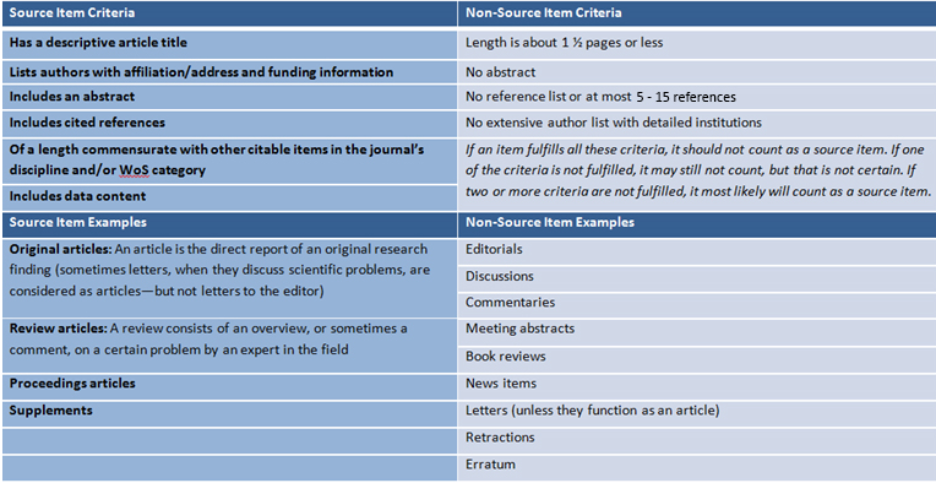
Clarivate Analytics indexes all document types in WoS. However, not all document types count for the Impact Factor calculation. Below is a general overview of which document types are source items—and thus counted in the Impact Factor calculation—and which are considered non-source items. These criteria are approximate and determined by Clarivate on a journal-by-journal basis.
Tips
Clarivate Analytics assigns article classifications based on journal sections. For example, if a section is titled “Editorials,” all articles published within that section are initially classified as editorials and are therefore treated as non-source items. However, Clarivate also evaluates individual articles on their own merits. If citable articles are identified within the Editorials section, Clarivate may reclassify the section, resulting in all articles within that section being treated as source items. Consequently, placing citable articles in the Editorials section to influence classification can have significant implications. Conversely, brief contributions that do not include a reference list may be published in the Editorials section and would generally not be counted as source items.
Further reading:
- "On indexing in the Web of Science and predicting journal impact factor" https://www.ncbi.nlm.nih.gov/pmc/articles/PMC2443356/
https://scholarlykitchen.sspnet.org/2016/02/10/citable-items-the-contested-impact-factor-denominator
- https://jamanetwork.com/journals/jama/fullarticle/184527
https://clarivate.libguides.com/jcr
Was this article helpful?
That’s Great!
Thank you for your feedback
Sorry! We couldn't be helpful
Thank you for your feedback
Feedback sent
We appreciate your effort and will try to fix the article